
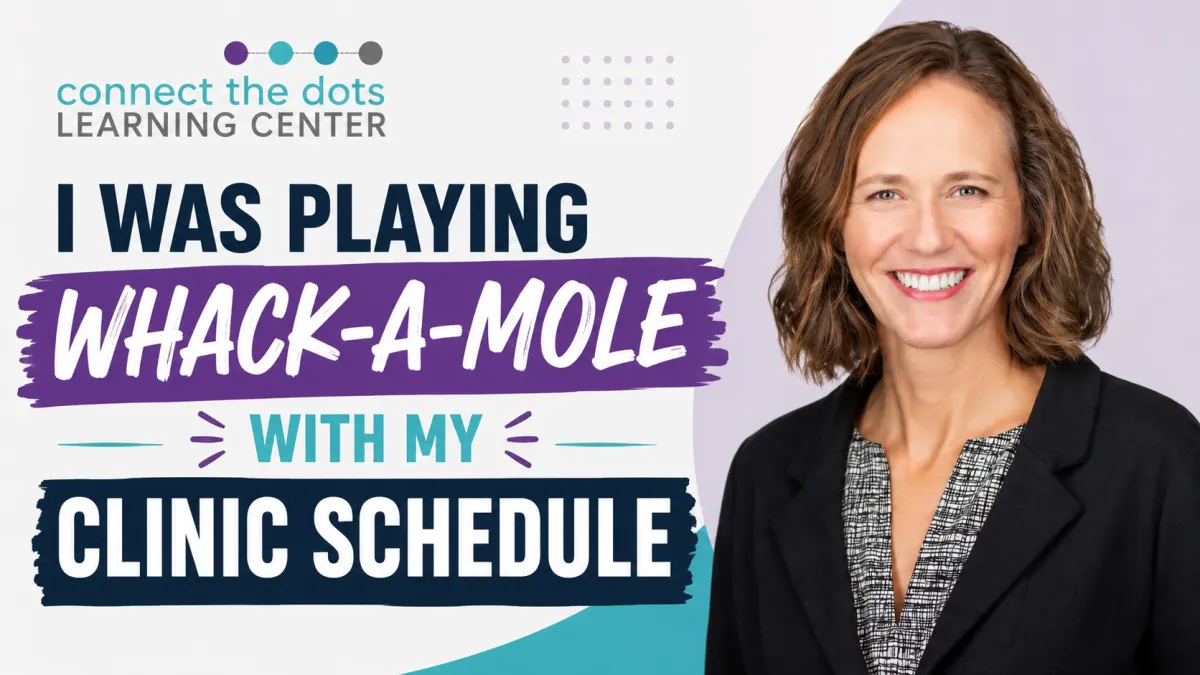
I Was Playing Whack-a-Mole With My Clinic Schedule
There was a point when running my pediatric clinic felt like one long game of whack-a-mole.
A cancellation popped up.
We filled it.
Another family stopped showing up consistently.
We sent reminders.
A therapist came to me frustrated because a parent wasn’t following through.
We addressed that.
Then another hole appeared in the schedule.
Whack.
Whack.
Whack.
From the outside, we had a successful pediatric practice.
From where I was sitting, I was having heart palpitations.
Our schedule felt unpredictable. Parents seemed disengaged. My team was frustrated. I was burned out.
Eventually, I became so disenchanted with practice ownership that I decided to go back to school.
At the time, I thought I was creating my exit plan.
Instead, I ended up discovering something that completely changed how I looked at my clinic.
I Thought I Needed a Way Out
When I went back for my post-professional doctorate, my plan wasn’t to become the parent engagement person.
I thought I might teach.
I had been in pediatric therapy for years. I had owned a clinic. I knew what it took to run a practice.
And frankly, I was tired.
When it came time to choose my capstone, I decided to study parent engagement.
I figured if I was going to leave practice ownership anyway, I might as well understand what was happening inside my own clinic first.
Why weren’t parents following through?
Why did some families seem completely bought in while others seemed checked out?
Why were therapists getting so frustrated?
Why did it feel like we were constantly working harder without fixing the problem?
I started digging into the research.
And what I found surprised me.
We Weren’t Seeing Trust the Same Way Parents Were
As providers, we tend to think parents trust us because we’re good at what we do.
We went to school.
We have the credentials.
We understand the diagnosis.
We know the treatment approach.
We can explain the clinical reasoning.
Of course competence matters.
But the research showed me that parents were looking for something else too.
They wanted a provider who could RELATE to them.
They wanted collaboration.
They wanted to feel like they were part of the process instead of standing outside of it.
That was a big realization for me.
Because suddenly, some of the behaviors I had been labeling as disengagement started looking different.
The Parent Who “Doesn’t Care” May Be Overwhelmed
Clinic owners hear versions of this all the time.
“They don’t do the home program.”
“They cancelled again.”
“They sit in the car.”
“They’re always on their phone.”
“They just don’t seem bought in.”
I’ve heard it from therapists.
I’ve thought it myself.
But the deeper I got into this work, the more I realized we needed to get curious before deciding what a parent’s behavior meant.
Maybe they don’t understand WHY therapy matters.
Maybe they don’t understand what you want them to do.
Maybe the home program feels like one more impossible thing on an already overwhelming list.
Maybe they don’t feel confident doing it correctly.
Maybe they feel judged every time they walk into your clinic.
If we immediately decide that parent “doesn’t care,” we miss the opportunity to figure out what is actually getting in the way.
And that means we keep playing whack-a-mole.
I Realized We Were Solving the Wrong Problem
We had been treating cancellations like a scheduling problem.
So naturally, we used scheduling solutions.
Reminders.
Policies.
Rescheduling.
Follow-up calls.
Those things have a place.
But they didn’t answer the bigger question.
WHY WAS THE FAMILY DISENGAGING IN THE FIRST PLACE?
That was the shift for me.
This wasn’t simply a parent motivation problem.
It wasn’t a therapist work ethic problem either.
IT WAS A SYSTEMS PROBLEM.
If parents don’t understand their role, we need a better way to explain it.
If therapists don’t know how to have difficult conversations, we need to teach them.
If every provider communicates differently, we need shared language.
If families don’t understand why attendance matters, we need to connect therapy to something meaningful in their everyday lives.
I could keep hitting each problem as it appeared.
Or I could change the system creating the problems.
Parent Engagement Had to Become Part of Therapy
One of the biggest lessons I learned was that we couldn’t treat parent engagement as something extra.
It had to become part of how we provided care.
That doesn’t mean giving parents more homework.
In fact, sometimes it means giving them LESS.
Instead of sending a parent home with 20 exercises, give them one thing they can realistically use this week.
Instead of telling them:
“We’re working on fine motor skills.”
Tell them:
“We’re working on this so your child can button their jacket without needing you to do it every morning.”
Now the goal connects to real life.
Parents need to understand why the work matters, what their role is, and what they can realistically do between sessions.
That’s when engagement starts becoming manageable instead of another demand on an already overwhelmed family.
My Therapists Needed Tools Too
This wasn’t only about changing how I thought about parents.
I also had to look at what I was asking my therapists to do.
We expect pediatric therapists to have some incredibly difficult conversations.
A parent isn’t following through.
A family keeps cancelling.
A child isn’t progressing.
The therapist needs the parent more involved.
Those conversations can be uncomfortable.
And telling a therapist, “You need to get the parent more engaged,” doesn’t teach them what to say.
They need language.
They need scripts.
They need opportunities to practice.
They need someone to help them work through conversations that didn’t go well.
They need repetition until those conversations start feeling more natural.
KNOWING parent engagement matters and KNOWING HOW to create it are two very different things.
That became a major part of the work for us.
Then Our Numbers Started Changing
Once we started implementing what I had learned, we began seeing changes inside the clinic.
In the transcript from my training, I share that our arrival rate was around 70 percent when we were beginning this work.
As we continued implementing these systems, we started seeing months around 90 percent and above.
For a clinic owner, that matters.
Every appointment that falls off your schedule affects more than one hour of revenue.
It affects your therapists.
It affects your front desk.
It affects families waiting for appointments.
It affects consistency.
And ultimately, it affects the child’s opportunity to make progress.
But the numbers weren’t the only thing that mattered to me.
My perspective had changed too.
I wasn’t looking at every cancellation as another problem I needed to smack down before the next one appeared.
I finally had a framework for understanding what might be underneath it.
I Went Back to School Looking for an Exit
That may be my favorite part of this story.
I went back to school because I thought I was done.
I was burned out.
I was tired of running a clinic.
I thought teaching might be my next chapter.
Instead, studying parent engagement gave me a completely different way to look at the problems that had been exhausting me.
It gave me something practical to bring back to my team.
And eventually, it gave me something I wanted to teach OTHER clinic owners.
Because I know what it feels like to look at your practice and think:
I cannot keep doing this.
Sometimes you don’t need to work harder.
Sometimes your therapists don’t need another productivity conversation.
And sometimes your parents don’t need another reminder.
You need to understand what’s driving the problem before you can build a system that actually addresses it.
Want to Go Deeper?
If you feel like you’re playing whack-a-mole in your pediatric clinic, cancellations here, therapist frustration there, parents who aren’t following through, and revenue that feels harder to predict than it should, this is the work I help clinic owners address.
My book, Meet Me Halfway, takes a deeper look at parent engagement and gives pediatric therapists and clinic owners practical ways to create stronger partnerships with families.
I also work with clinics that want help moving these ideas beyond a book or training and into the way their team actually operates.
If you’re tired of fixing the same problems over and over, explore my programs or schedule a Discovery Call. We can look at what’s happening inside your clinic and identify where your parent engagement systems may need support.
Follow Connect The Dots Learning Center:

🎙️PODCAST: ctd-learn.com/ctdlcpodcast
▶️ YOUTUBE: www.youtube.com/@StephanieWagers
🅾 INSTAGRAM: https://www.instagram.com/ctdlearningcenter/
ⓕ FACEBOOK: https://www.facebook.com/connectthedotslearningcenter